Impacted Members/Scientists: Request a membership waiver, seek meeting support, and other resources. Learn more. For the latest public policy updates, please visit this page.




11 July 2024
This Month in Astronomical History: July 2024
Ananya Kaalva
University of Texas at Austin
(Astronomy Undergraduate)
 Each month as part of this series from the AAS Historical Astronomy Division (HAD), an important discovery or memorable event in the history of astronomy will be highlighted. This month, Ananya Kaalva writes about the career of Beatrice Tinsley. Interested in writing a short (500-word) column? Instructions along with previous history columns are available on the HAD web page.
Beatrice Tinsley: Pioneer of Galactic Evolution
On 1 July 1978, Beatrice Tinsley became a professor of astronomy at Yale University. Yale had hired her as an associate professor in 1975, after her rejection for a similar position by the University of Texas at Dallas. Following the award of her doctorate at UT Austin in 1967, Tinsley was a visiting scientist at the Hale Observatory, the Lick Observatory, Caltech, and the University of Maryland. Before dying of melanoma in 1981, she published over 100 papers on galaxies.
Beatrice Tinsley’s passion for science began very early in her life. Born in Chester, England, in 1941, she exhibited an innate curiosity throughout her childhood. Her father recounted her early scientific inquiries, stating that she never stopped asking questions about the world around her.1 After World War II, Tinsley’s family relocated to New Zealand, where she continued her pursuit of physics and astronomy through a junior scholarship in chemistry, mathematics, and physics at Canterbury University. She graduated with a Master of Science with First Class Honors in Physics in 1961.2
While at Canterbury, Tinsley met and married fellow physicist Brian Tinsley, who developed a novel spectrogram. Upon her marriage, she encountered many barriers to her own employment in New Zealand due to her gender and role as a wife, despite her shining academic credentials. As a result, the couple moved to the United States when Brian Tinsley was offered a position at the Southwest Center for Advanced Studies (now the University of Texas at Dallas). However, her time in Dallas proved to be equally as challenging as in her hometown, because she was mainly given roles associated with being the wife of a faculty member.3 Tinsley refused to conform to the expected role of a faculty wife, which involved hosting social events rather than engaging in academic discourse. She instead attended most of the academic talks and discussions in the astrophysics group. Eventually, she enrolled at the University of Texas at Austin to further her studies in cosmology where she was the only woman in the program. She commuted over 400 miles weekly to pursue her passion.4
As a doctoral candidate at the University of Texas at Austin, Tinsley conducted groundbreaking research in the field of galaxy evolution.5 She focused on the aging processes of star groups within galaxies, simulating the behavior of billions of stars over two years, which she then proved to extrapolate to the larger timescale trends in the appearance and characteristics of galaxies themselves.6 Her work challenged the prevailing assumption that galaxies of the same type (elliptical, spiral, etc.) had uniform sizes, shapes, and luminosities. She found instead that their evolution relied on more complex parameters including chemical abundances, mass, and star formation rates.5 This discovery went on to further refine the process of determining the expansion rate of the universe by providing a more accurate measure of a galaxy’s age and distance, which are key factors in the calculation of Hubble’s Law.2
A defining moment in Tinsley’s career occurred in 1967 when Tinsley, at just 26 years old, courageously criticized renowned astronomer Allan Sandage during his lecture at the University of Texas at Dallas. Sandage proposed a closed universe theory, presenting his idea that the universe would end in a “big crunch” or cosmic-scale contraction at the end of some determined lifespan. Tinsley instead proposed that he had not properly accounted for the light of distant galaxies, failing to include the parameters of a galaxy’s dynamical chemical and photometric evolution.4 She further challenged Sandage by publishing a paper titled “An Unbound Universe?” along with colleague David Schramm and astrophysicists James Gunn and J. Richard Gott from the University of Maryland in the Astrophysical Journal.7 Gunn described Tinsley as the glue of the group, writing a majority of the paper itself and boldly opening with a pointed quote from Lucretius about accepting the novel idea that the universe is unbounded.4
Beatrice Tinsley completed her PhD at the University of Texas at Austin in 1966, taking a record time of only two years to defend her thesis titled “Evolution of Galaxies and its Significance for Cosmology.” She was the first student at her institution to achieve marks higher than 80% on all of her papers and dissertation requirements.2 Tinsley continued her postdoctoral research in Texas, accepting temporary positions as a visiting scholar at other institutions. She received the Annie Jump Cannon Award from the American Astronomical Society in 1974.3
However, due to her status as a woman, Tinsley was not offered employment at the University of Texas at Austin, despite her contributions in establishing their Department of Astronomy. Realizing that her status as a wife and mother barred her opportunities to develop her career, Tinsley made the difficult decision to divorce her husband and give up custody of her children to pursue a full-time faculty position at Yale University, becoming the first woman appointed as a professor of astronomy there.3 She described to her father in a letter that her decision gave her “a sense of hope and power over the future” that she had not previously experienced. Her daughter, Teresa, later reflected on this period, stating, “She was given an ultimatum that in my opinion was unfair: Choose family or a career...I am proud that she stood her ground and followed her career.”1
At Yale, Tinsley organized and hosted a pivotal symposium on the evolution of stars and galaxies in 1977. The proceedings, which she co-edited, became a standard and important reference for researchers in the fields of cosmology and galactic evolution and structure. Over her 14-year career, she authored over 100 papers, pioneering techniques such as redshift-magnitude diagrams to study galaxy evolution.4 Her work led to the development of the fields of chemical and isotopic evolution of matter through nucleosynthetic processes, the stellar luminosity function, and the physics of highly evolved stars. She gave numerous talks throughout the astronomical community worldwide, set precedents for women in astrophysics, and mentored many graduate students during her career.5
Tragically, Tinsley’s career was cut short when she succumbed to melanoma in 1981 at the age of 40. Her legacy, however, endures through numerous honors and awards. In 1985, the American Astronomical Society established the Beatrice M. Tinsley Prize to recognize outstanding and innovative research in astronomy or astrophysics.5 Other tributes include the Beatrice Hill Tinsley Lectures by the Royal Astronomical Society of New Zealand, the Hill Tinsley Research Medal by the New Zealand Association of Scientists, and the Tinsley Scholars award for young researchers at the University of Texas at Austin. In 1989, the University of Austin established the Beatrice M. Tinsley Centennial Visiting Professorship to invite distinguished professors to the university campus for up to a semester to support the widespread distribution of their knowledge and expertise. Additionally, asteroid 3087, discovered in 1981, was named in her honor.2
Beatrice Tinsley’s story was one of perseverance, intellectual bravery, and groundbreaking scientific contributions. Her work laid the foundation for contemporary cosmology. Her struggles led to countless advancements in the empowerment of women in the fields of physics and astronomy, and her legacy continues to inspire and pave the way for future generations of scientists.
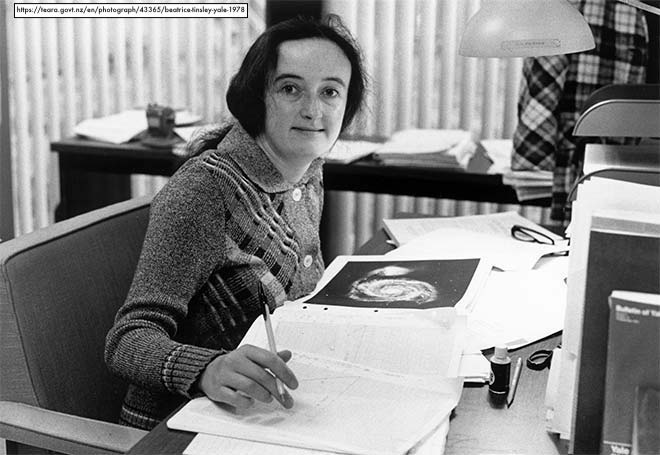
Fig. 1: Beatrice Tinsley at her Desk, Yale 1978. (Te Ara: the Encyclopedia of New Zealand. https://teara.govt.nz/en/photograph/43365/beatrice-tinsley-yale-1978)
Notes & References
- Hill, E., 1986. “My Daughter Beatrice. A Personal Memoir of Dr. Beatrice Tinsley, Astronomer,” New York: The American Physical Society, p. 65-66
- https://www.sheisanastronomer.org/history/beatricetinsley
- https://www.canterbury.ac.nz/about-uc/why-uc/our-alumni/uc-legends/beat…
- https://www.nytimes.com/2018/07/18/obituaries/overlooked-beatrice-tinsl…
- https://pubs.aip.org/physicstoday/article/34/9/110/433534/Beatrice-Tins…
- Tinsley, B. M., 1980. “Evolution of Stars and Gas in Galaxies,” Yale University Observatory: Fundamentals of Cosmic Physics, Vol. 5, p. 287-388
- Gott, J. R., Gunn, J. E., Schramm, D. N., Tinsley, B. M., 1974. “An Unbound Universe?” The Astrophysical Journal, 194, p. 543-553